Tanager-M · an open engineering study · 2026

Small enoughto build.

A compact, high-field stellarator sized to what today's superconductors, steels and shields can really do. Then put through ten simulated tests, including two days nonstop, with every result shown, good or bad.

The reactor, reduced

7× less plasma.
Same physics.

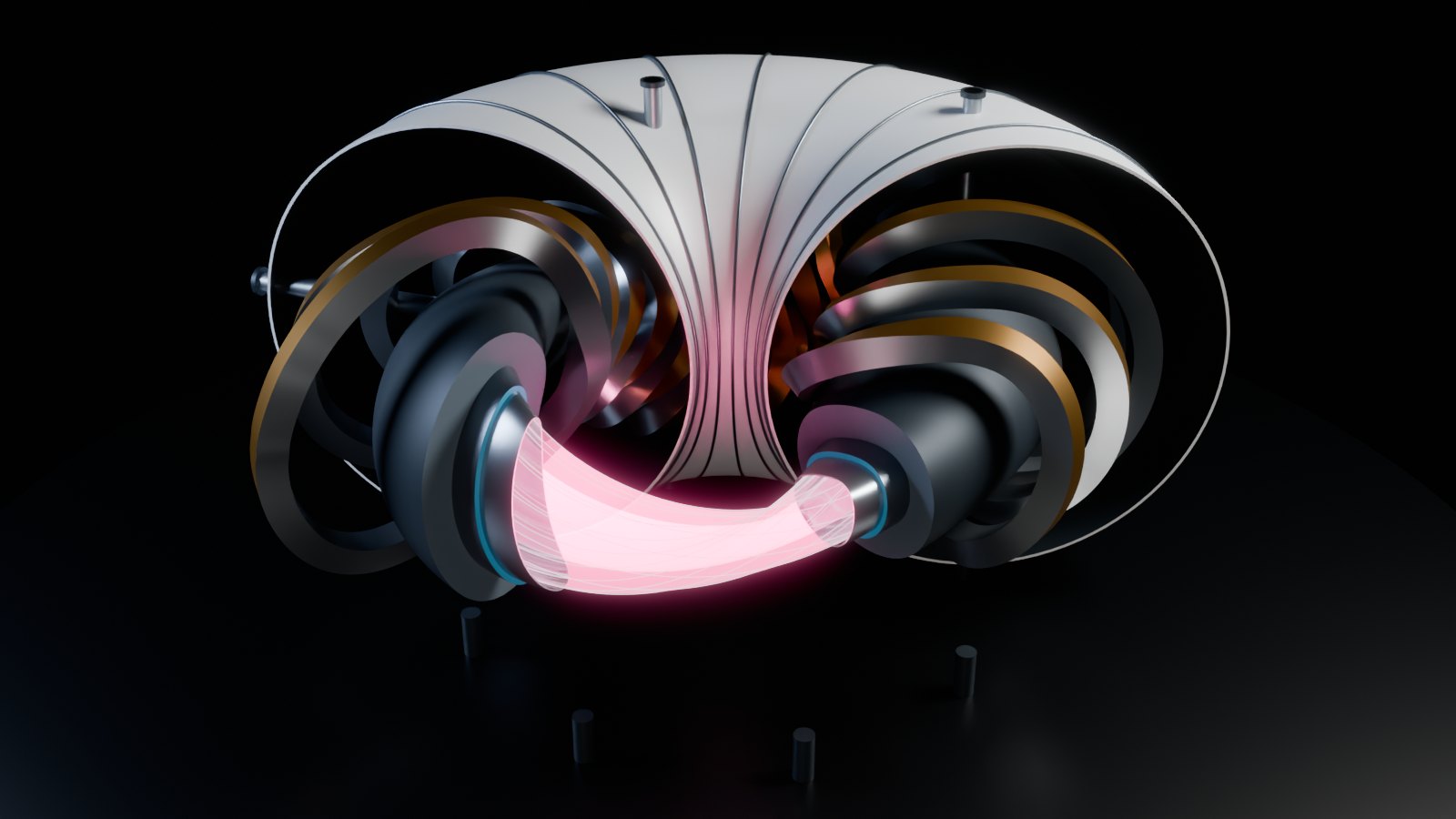
The first Tanager was a 12 m power-plant concept. Tanager-M keeps its ideas and shrinks to the smallest machine that can still burn deuterium-tritium fuel.

4.8mMajor radius, plasma centre
8.2TField on the plasma
38MWSteady fusion power, best case
0.97QFusion gain, best case (0.34 baseline)

Baseline uses the world-average stellarator confinement law (ISS04). Best case uses the best confinement Wendelstein 7-X has measured, 30 % above that law. Everything on this page is a simulation result, not a measurement.

Why this size

Three hard limits set the scale.

  1. Magnet

    20 tesla, and no more

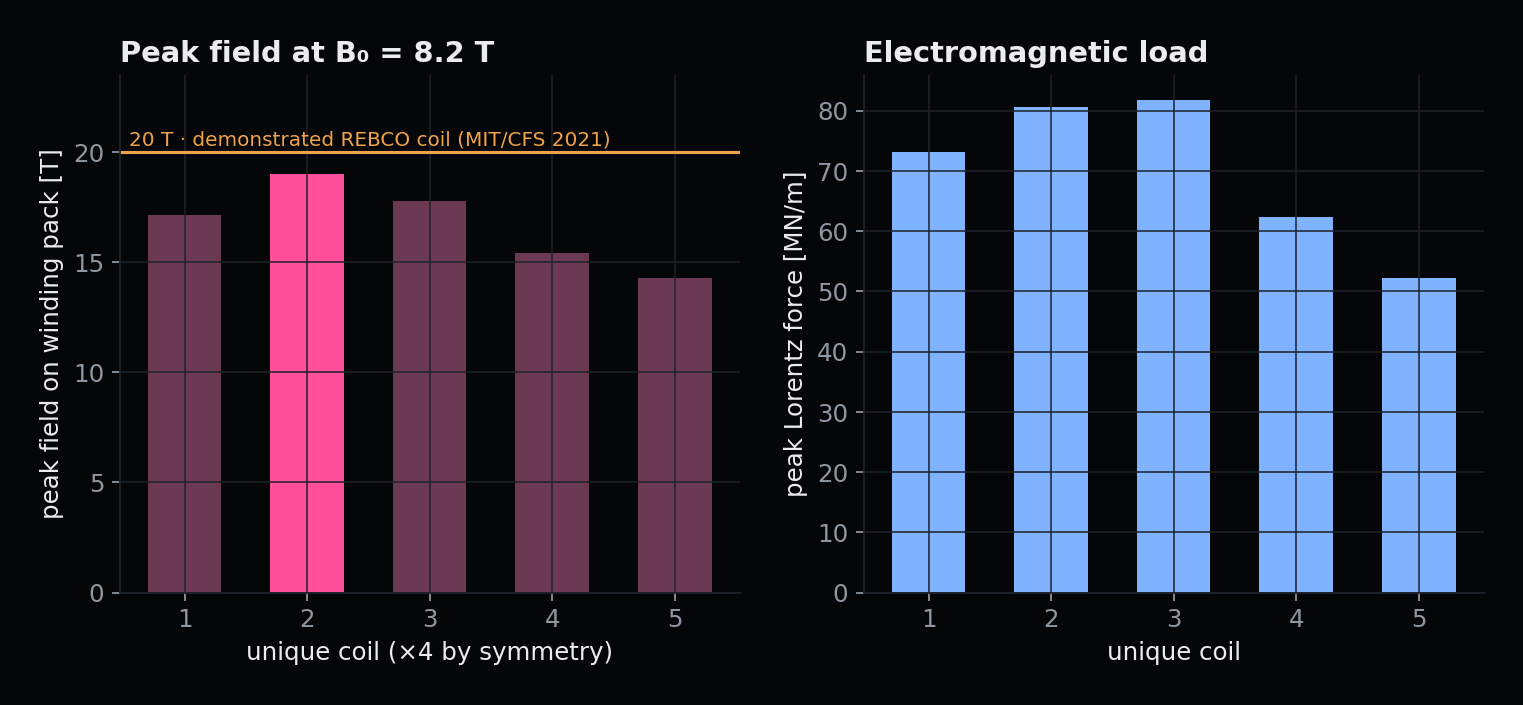
    REBCO superconductor has been proven at 20 T in a large coil. The optimised coils see 2.32× the plasma's field at their hottest spot, so the plasma gets 8.2 T.

  2. Shield

    The shield doesn't shrink

    60 cm of tungsten carbide is what keeps neutrons out of the superconductor. Shrink the machine and that layer stays the same, so it eats the space the plasma needs.

  3. Heat

    Insulation grows with size

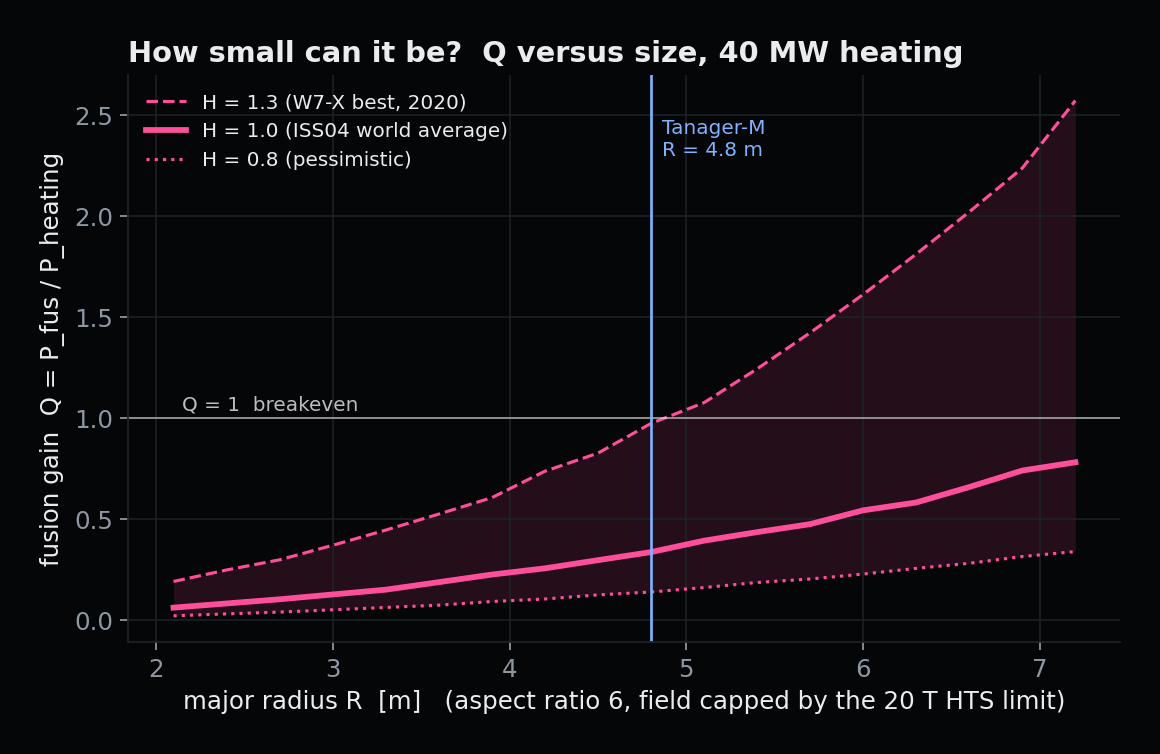
    A stellarator holds heat roughly as its radius to the power 2.3. Below about 5.1 m the plasma can't pay back its heating, even with the best confinement ever measured.

01 / 06

D-T plasma

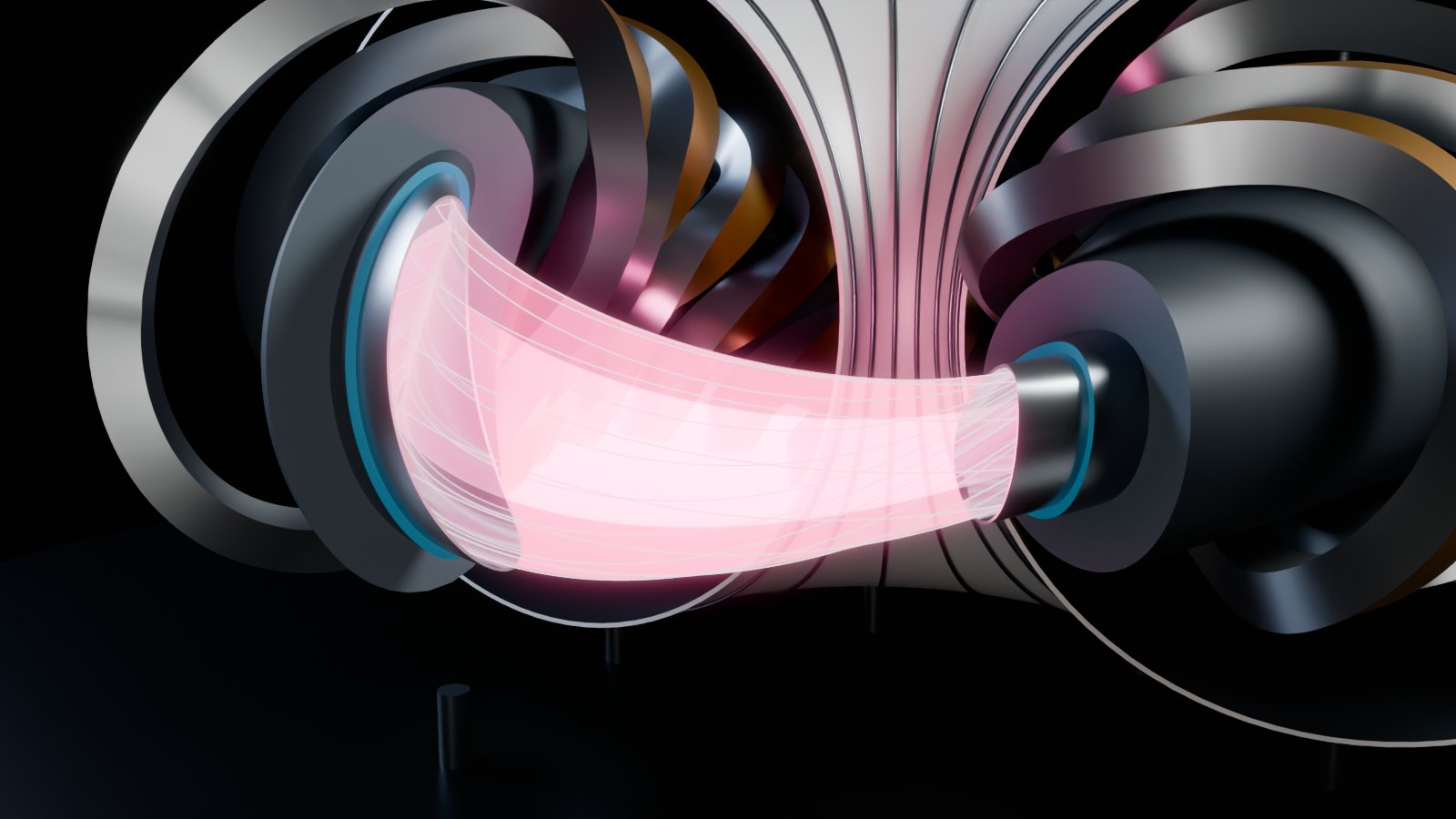
Deuterium and tritium at 80 million °C in the core. The shape is a published, precisely quasi-symmetric plasma, solved here with DESC at finite pressure with its own bootstrap current.

Volume
61 m³
Core
6.9 keV
Periods
2

02 / 06

Tungsten first wall

Tungsten armour on water-cooled reduced-activation steel, the same recipe planned for Europe's DEMO. No liquid metal: this version sticks to what has been built.

Neutron load
0.05 MW/m²
Damage
0.3 dpa / full-power yr

03 / 06

Vacuum vessel

A double steel wall filled with borated steel plates and water, as in ITER's vessel. It holds the vacuum and does the first round of neutron shielding.

Thickness
10 cm
Heat taken
5.6 MW

04 / 06

Tungsten carbide shield

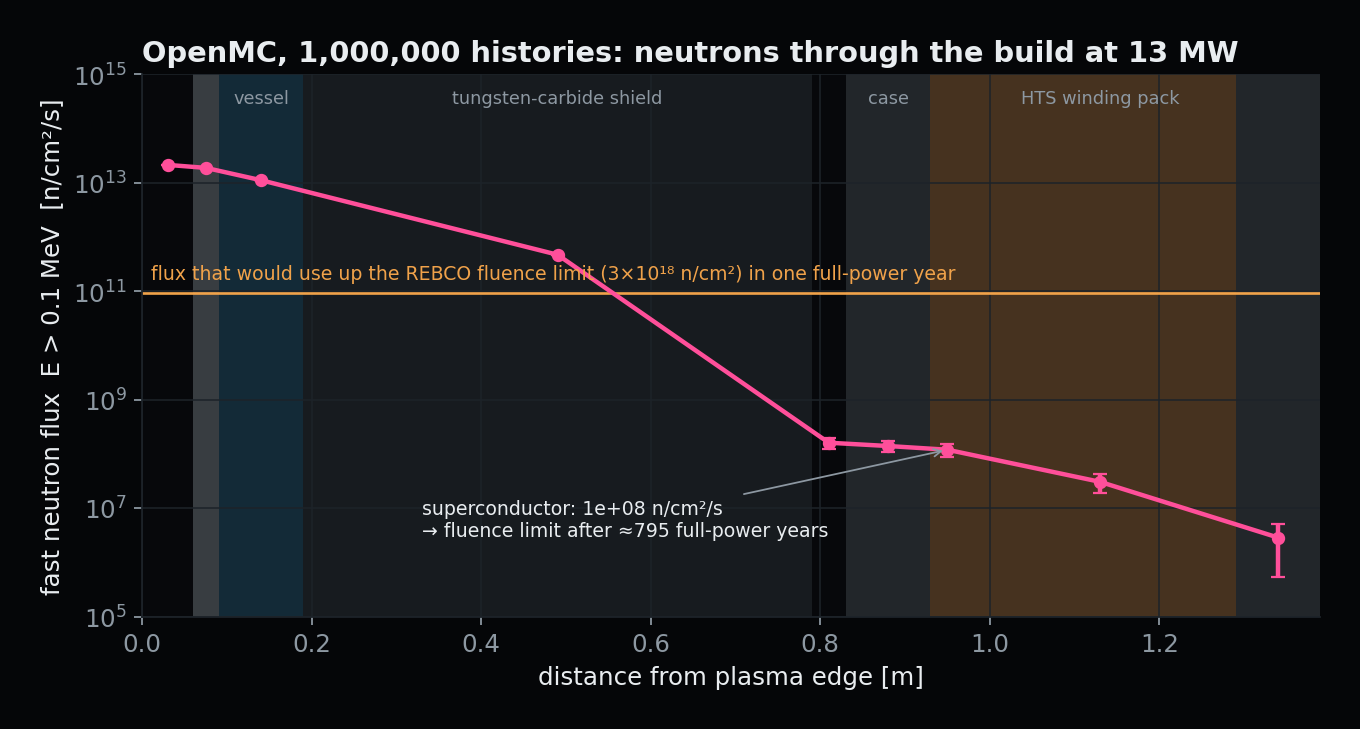
60 cm of tungsten carbide with water cooling. The optimised coils sit 1.1 m from the plasma, so the space in between became shielding. OpenMC traced 1,000,000 neutrons through it: the fast flux drops about 1.6 × 10⁵× before the superconductor.

Magnet life
≈800 full-power yrs
Heat on coils
152 W

05 / 06

20 optimised HTS coils

Every coil shape on screen came out of a SIMSOPT optimisation: five unique coils, repeated four times, that recreate the plasma boundary to 0.12 % while leaving room for the shield.

Peak field
19.0 T
Force
up to 82 MN/m
Tape
≈ 14,600 km

06 / 06

Cryostat

Holds the coils near 20 K. The whole machine is a little wider than Wendelstein 7-X's 16 m cryostat and would fit in a large sports hall.

Diameter
≈ 20 m
Height
≈ 10 m

The test campaign

Ten tests. Real tools.

Each test uses open research code that fusion scientists use: DESC for the plasma, SIMSOPT for the coils, OpenMC with ENDF/B-VIII.0 nuclear data for the neutrons. The verdicts are mine.

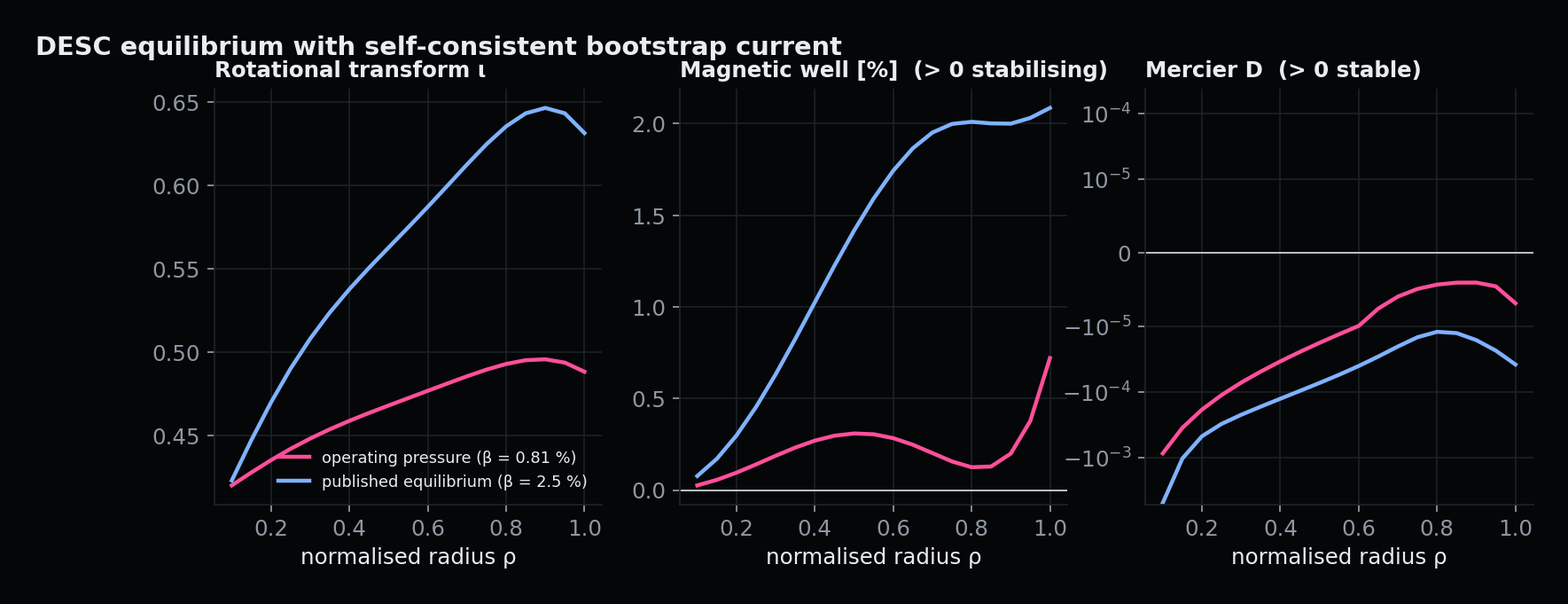
Profiles of rotational transform, magnetic well and Mercier stability across the plasma radius
TEST 01LIMIT

Does the plasma hold together?

DESC · 3-D MHD equilibrium at operating pressure

Re-solved at Tanager-M's real pressure (β 0.81 %) with its own bootstrap current. It keeps a magnetic well everywhere, but the Mercier stability number sits just below zero across the radius. Marginal: the next optimisation needs a stability target.

Magnetic well
0.06–0.7 %
Mercier
marginal, −10⁻⁵
Twist ι
0.42–0.50
Bar charts of peak field and peak force for the five unique coils against the 20 T line
TEST 02PASS

Do the magnets survive?

Biot–Savart, finite winding pack, regularised self-field

Peak field on the superconductor is 19.0 T, inside the 20 T that REBCO has shown in a large coil. Dropping the winding-pack current density to 100 A/mm² cut the peak by 12 % and bought the plasma 0.9 T. Forces reach 82 MN/m; a 10 cm steel case carries them.

Peak field
19.0 T
Peak / axis
2.32×
REBCO tape
≈ 14,600 km
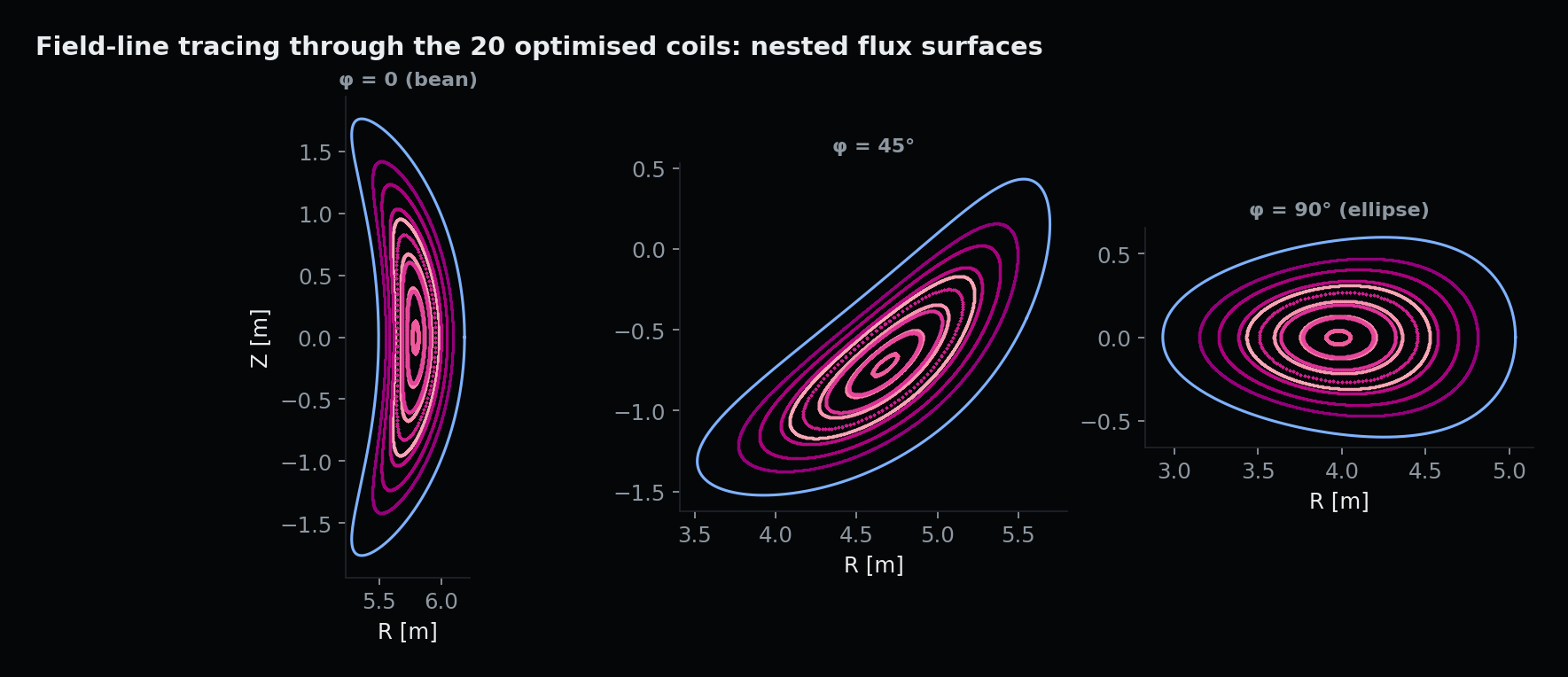
Three Poincaré cross-sections showing nested magnetic surfaces inside the target plasma boundary
TEST 03PASS · EDGE OPEN

Can real coils make that field?

SIMSOPT · coil optimisation + field-line tracing

Twenty coils recreate the plasma boundary to 0.12 % mean field error while staying at least 1.11 m from the plasma, which leaves room for the shield. Traced field lines form nested surfaces out to 90 % of the target radius; the last 10 % is still open.

Field error
0.12 % mean
Closed surfaces
90 % of radius
Min bend radius
0.43 m
Line chart of fusion gain versus major radius for three confinement assumptions
TEST 04LIMIT

How small can it be?

0-D power balance, calibrated to Stellaris

Size scanned at fixed shape, heating capped at 40 MW, field capped by the magnets. With world-average confinement nothing under 7 m breaks even. With W7-X's best confinement, breakeven starts near R ≈ 5.1 m. Tanager-M sits right at that line.

Q baseline
0.34
Q best case
0.97
Fusion power
13–38 MW
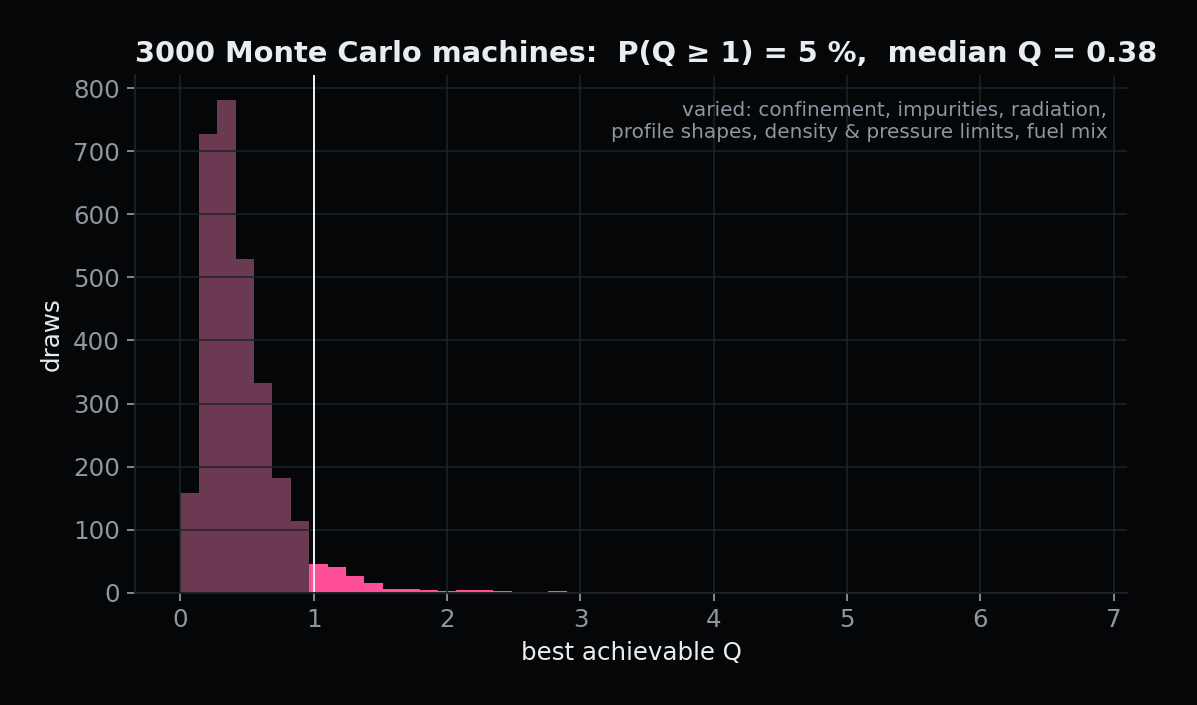
Histogram of best achievable Q across Monte Carlo draws
TEST 05OPEN

How likely is breakeven?

Monte Carlo · 3,000 machines

Every uncertain input varied at once: confinement, impurities, radiation, profile shapes, density and pressure limits, fuel mix. The answer is a probability, not a promise, and it's low.

P(Q ≥ 1)
5 %
Median Q
0.38
10–90 %
0.17–0.82
Time traces of fusion power, heating and alpha heating through start-up, flat-top and two trips
TEST 06PASS

Is the burn stable, and does it stop?

1-D time-dependent transport

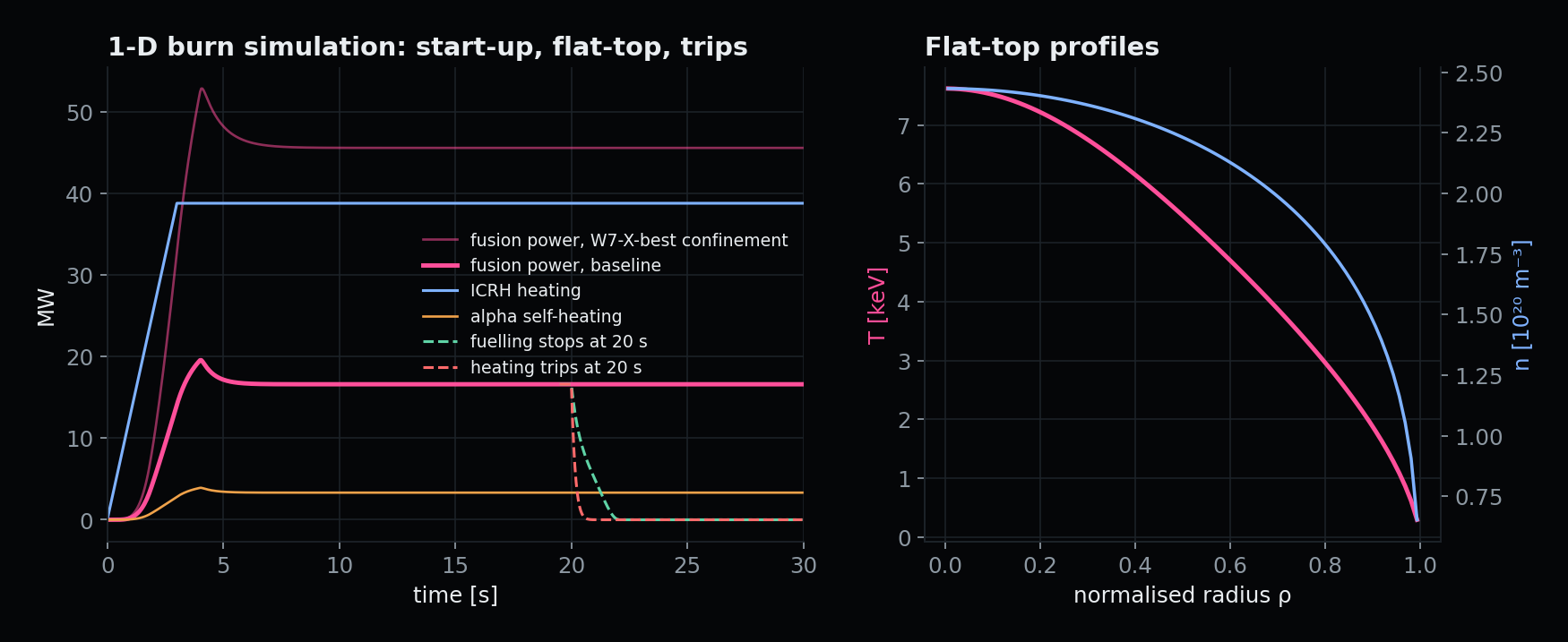
Start-up to a steady burn in about 6 s. A 30 % density kick settles back by itself. Cut the heating and fusion falls below 1 % in 0.7 s; stop the fuel and it takes 1.9 s. The 1-D model lands 20–25 % above the 0-D numbers.

Stop after heat trip
0.7 s
Stop after fuel cut
1.9 s
1-D Q
0.43–1.17
Bar chart of tritium breeding ratio for three FLiBe blanket options against the 1.0 and 1.1 lines
TEST 07LIMIT

Could the full-size plant breed its fuel?

OpenMC · FLiBe blanket on the 12 m Tanager

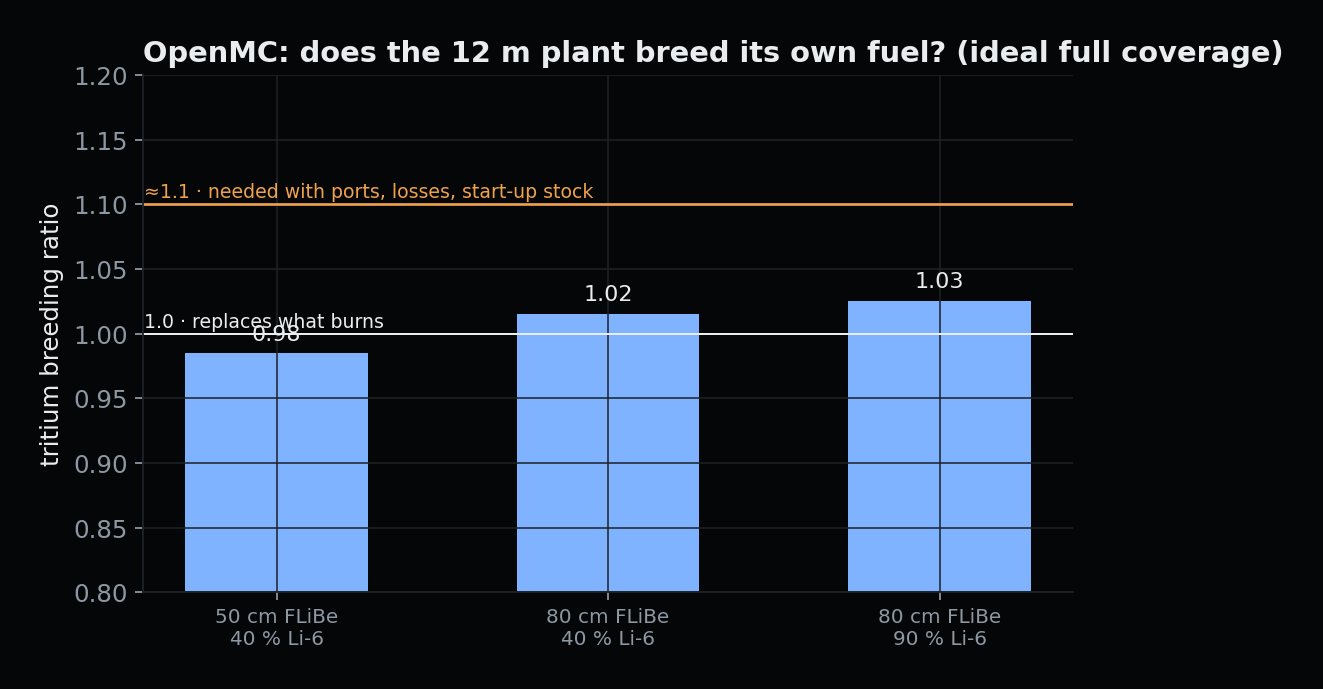
A check on the original concept. Even with perfect coverage, 50 cm of FLiBe breeds 0.98 tritium per burned; 80 cm at 90 % lithium-6 reaches 1.03. A real plant needs about 1.1, so the blanket needs a neutron multiplier.

TBR, 50 cm
0.98
TBR, 80 cm enriched
1.03
Needed
≈ 1.1
Fast neutron flux falling through first wall, vessel, shield and coil on a log scale
TEST 08PASS

What do the neutrons do?

OpenMC · ENDF/B-VIII.0 · 1,000,000 histories

Neutrons and gammas traced through every layer. The coils sit 1.11 m out, so the space became 60 cm of tungsten carbide: it cuts the fast flux about 1.6 × 10⁵×. The superconductor would take ≈800 full-power years to reach its damage limit; the coils absorb about 152 W.

Magnet life
≈800 FP years
Wall damage
0.3 dpa/FPY
Heat on coils
152 W
Histogram of how much of 48 hours each simulated run spent burning, and a bar chart of what stopped the plasma
TEST 09OPEN

Can it run for two days straight?

48-hour plant simulation · 400 runs with random faults

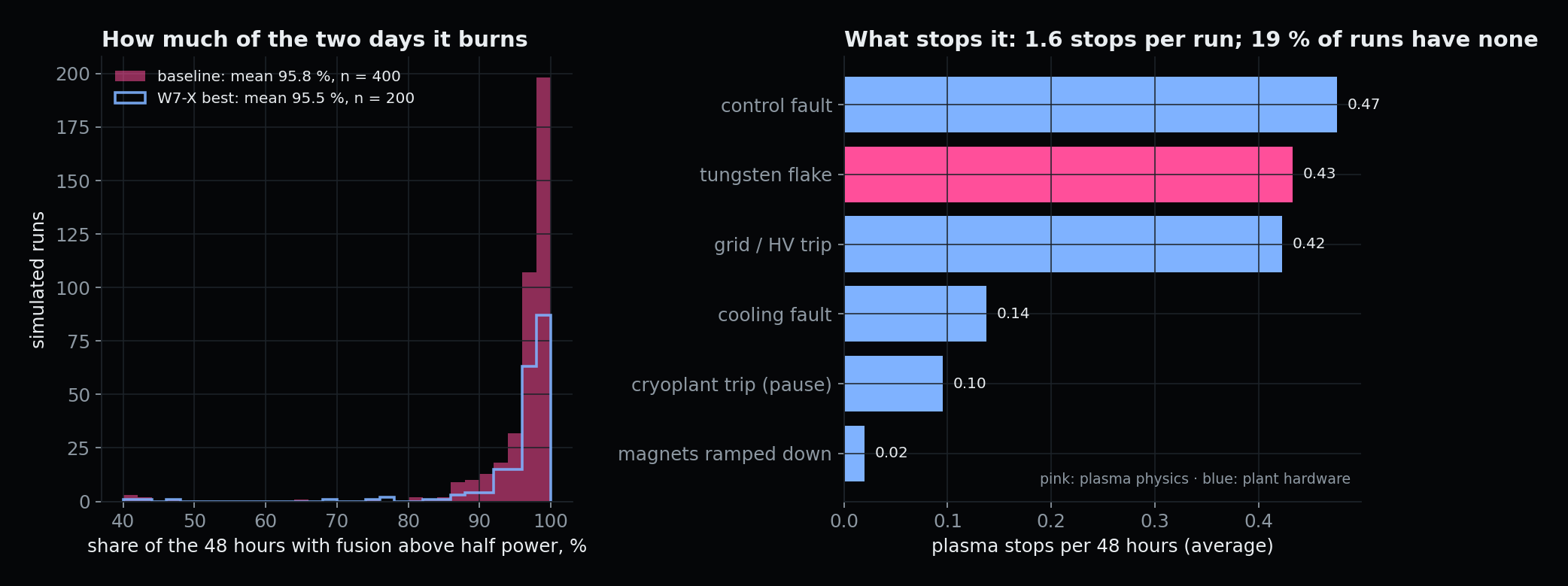
Every 20 ms for 48 hours: plasma, divertor, fuelling, pumps, tritium, cooling and magnets, with faults drawn at rates taken from today's hardware. On average it burns 96 % of the time and stops 1.6 times; 19 % of runs never stop. Tungsten flakes are the main plasma threat. The full 48 hours →

Burning
96 % of 48 h
Stops
1.6 per run
No stop at all
19 % of runs
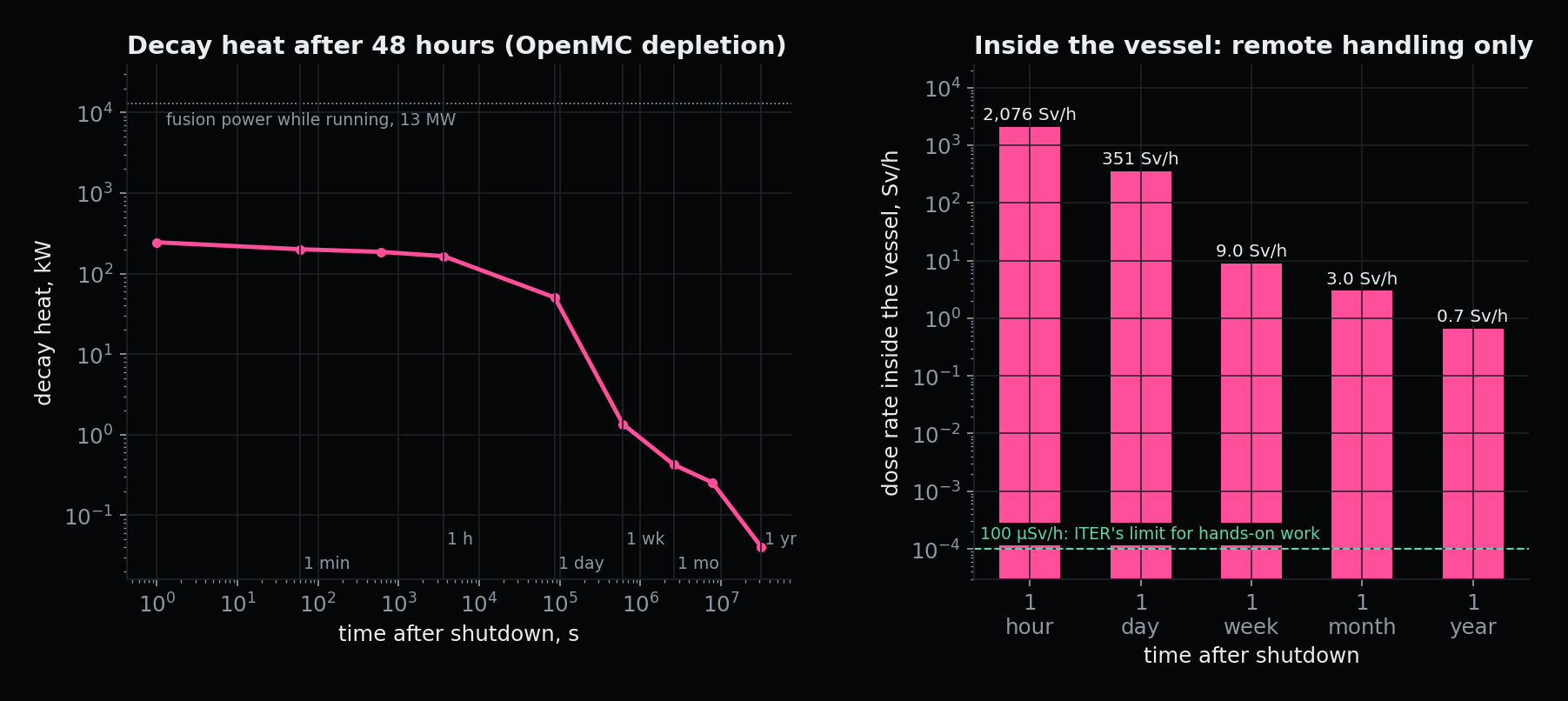
Decay heat falling over a month after shutdown, and in-vessel dose rate at five times after shutdown against the 100 microsievert per hour hands-on limit
TEST 10LIMIT

What's left after 48 hours?

OpenMC depletion · ENDF/B-VIII.0 chain · shutdown dose

Two days of neutrons activate the steel and tungsten. At shutdown the structure gives off 243 kW of decay heat (1.9 % of fusion power) and 51 kW a day later, mostly from tungsten-187. Inside the vessel the dose is 351 Sv/h after a day and 657 mSv/h after a year, so maintenance has to be remote.

Decay heat, 1 day
51 kW
In-vessel, 1 day
351 Sv/h
In-vessel, 1 year
657 mSv/h

Code, inputs and outputs for every test are in the Tanager-M test kit. Re-run it and you get the same numbers.

Test 09 · endurance run

48 hours.
Nonstop.

Switch it on and leave it for two days. Large fusion machines today hold plasma for minutes: France's WEST set the tokamak record of 22 minutes in 2025, on 2 MW of heating, and Japan's LHD stellarator ran about an hour in 2005. This run asks for 48 hours at 39 MW, with the hardware failing the way real hardware does.

96%Of the 48 hours spent burning, average of 400 runs
1.6stopsPlasma stops per 48 hours, on average
19%Of runs that never stop
636MWhFusion energy if nothing breaks
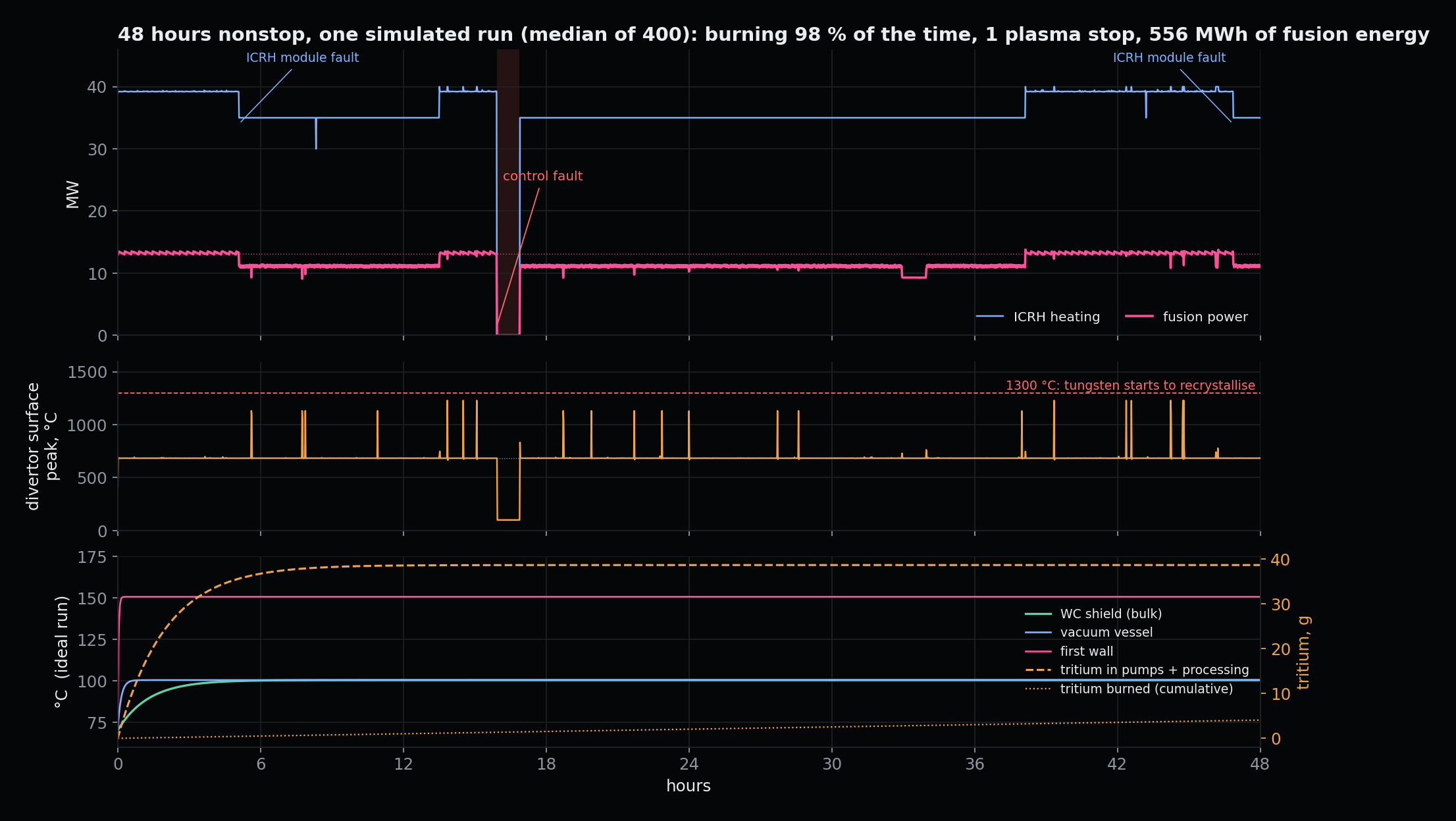
Three stacked time charts over 48 hours: fusion and heating power with shaded stops, divertor surface temperature, and component temperatures with tritium inventory
One simulated run, the median of 400. Red bands are plasma stops.
  1. Every 20 ms

    The control loops never rest

    Heating holds the stored energy, pellets hold the density, neon holds the divertor at 689 °C. About 6 pellets a second: 1.05 million over two days.

  2. First hours

    The shield takes 4 hours to warm up

    First wall and vessel settle in minutes. The 60 cm tungsten-carbide shield is so heavy it needs about 4 hours to reach its working temperature of 100 °C.

  3. Every 15 min

    A kilogram of tritium goes round

    Six cryopumps take turns regenerating. About 1.0 kg of tritium passes through the plant, but only 4.1 g is burned. Pumps and processing hold up to 39 g at once; 0.4 g sticks in the walls.

  4. At random

    What stops it

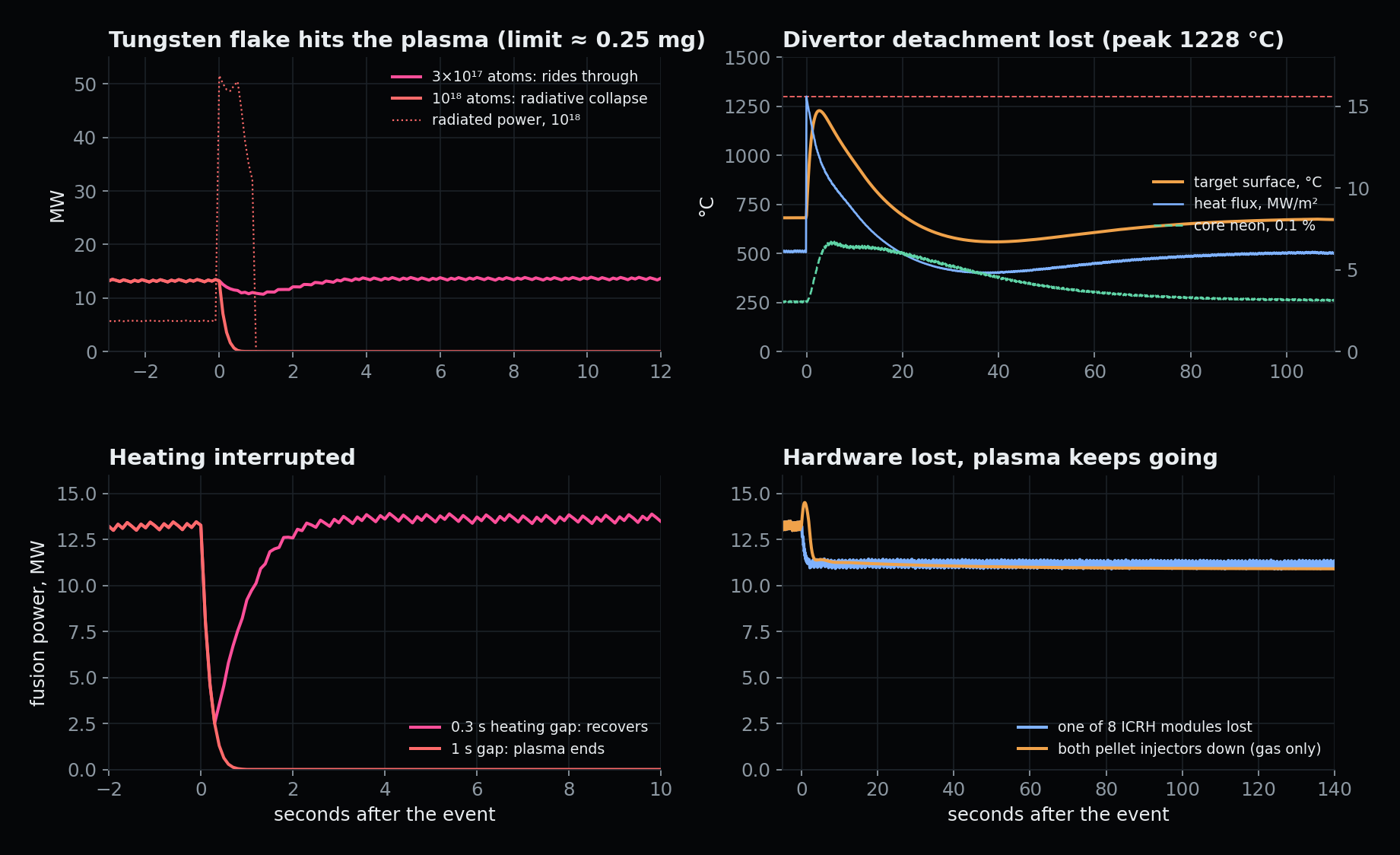
    Grid or power-supply trips (0.42 per run), control faults (0.47) and tungsten flakes (0.43). Anything heavier than 0.25 mg of tungsten, a speck 0.29 mm across, radiates the plasma away in under a second. Most restarts take 20 to 60 minutes. In 2 % of runs a long cryoplant outage forces the magnets down, which ends the run.

  5. Hour 48

    Heat, radioactivity, and a power bill

    The plant draws about 4.5 GWh from the grid and makes 636 MWh of fusion energy: it is still a net consumer. At shutdown the structure gives off 243 kW of decay heat, and the vessel reads 351 Sv/h a day later.

Four zoomed charts: a tungsten flake that the plasma survives and one that ends it, a detachment loss heating the divertor, short and long heating gaps, and lost hardware
Single events, zoomed. Detachment loss peaks at 1,228 °C and recovers.

0-D plasma around the design point, stepped every 20 ms, with OpenADAS radiation for tungsten, neon and helium. Fault rates are assumptions from today's hardware: halve them all and 51 % of runs never stop; double them and 4 % do. With W7-X-best confinement it makes 1,824 MWh if nothing breaks, but flakes stop it more often (0.8 per run): its denser plasma radiates more tungsten power and its heating is already at the 40 MW limit.

Operating points

Two confinement cases.
One machine.

Fusion power
13 MW
Fusion gain Q
0.34
Heating (ICRH)
39 MW
Alpha self-heating
2.6 MW
Magnet life
800 full-power yrs
Tritium burned
2.0 g/day

0-D power balance. Both cases keep density under the stellarator limit, pressure under 3 % of magnetic pressure and heating at 40 MW or less. The 1-D burn simulation gives Q 0.43–1.17.

Against standard reactors

Where it wins.
Where it doesn't.

Swipe the table →

Tanager-MAP1000 PWRNuScale moduleeVinci microSPARCITER
Typefusion · stellaratorfissionfission · SMRfission · microfusion · tokamakfusion · tokamak
Statusdesign, simulatedoperating (Vogtle 3 & 4)NRC standard design approval (2025)zero-power criticality testsassembly, first plasma 2027construction, D-T 2039
Power13–38 MW fusion (steady)3,415 MWt / ~1,117 MWe250 MWt / 77 MWe15 MWt / 5 MWe140 MW fusion, 10 s pulses500 MW fusion, 400–600 s
Gain / net powerQ 0.34–0.97 · net electric: no— · net electric: yes— · net electric: yes— · net electric: yesQ ≈ 11 predicted (>2 minimum) · net electric: noQ = 10 target · net electric: no
Fuel in the machine≈37 mg D-T in the plasmatens of tonnes of uraniumLEU coreTRISO, 19.75 % HALEU, 8+ yr core——
Runaway riskimpossible: burn stops in ~1 s without fuel or heatingprevented by design; needs decay-heat coolingpassive safetypassive heat pipesdisruptions possible (tokamak)disruptions possible (tokamak)
After shutdown≲1 % of fusion power (activation)≈6.5 % at shutdown (~220 MW)≈6.5 % at shutdown (~16 MW)≈6.5 % at shutdown (~1 MW)smallsmall
Wasteactivated steel & tungsten, no spent fuelspent fuel, long-lived actinidesspent fuelspent TRISO fuelactivated structureactivated structure
Weapons materialno fissile materialplutonium in spent fuelplutonium in spent fuelHALEU——
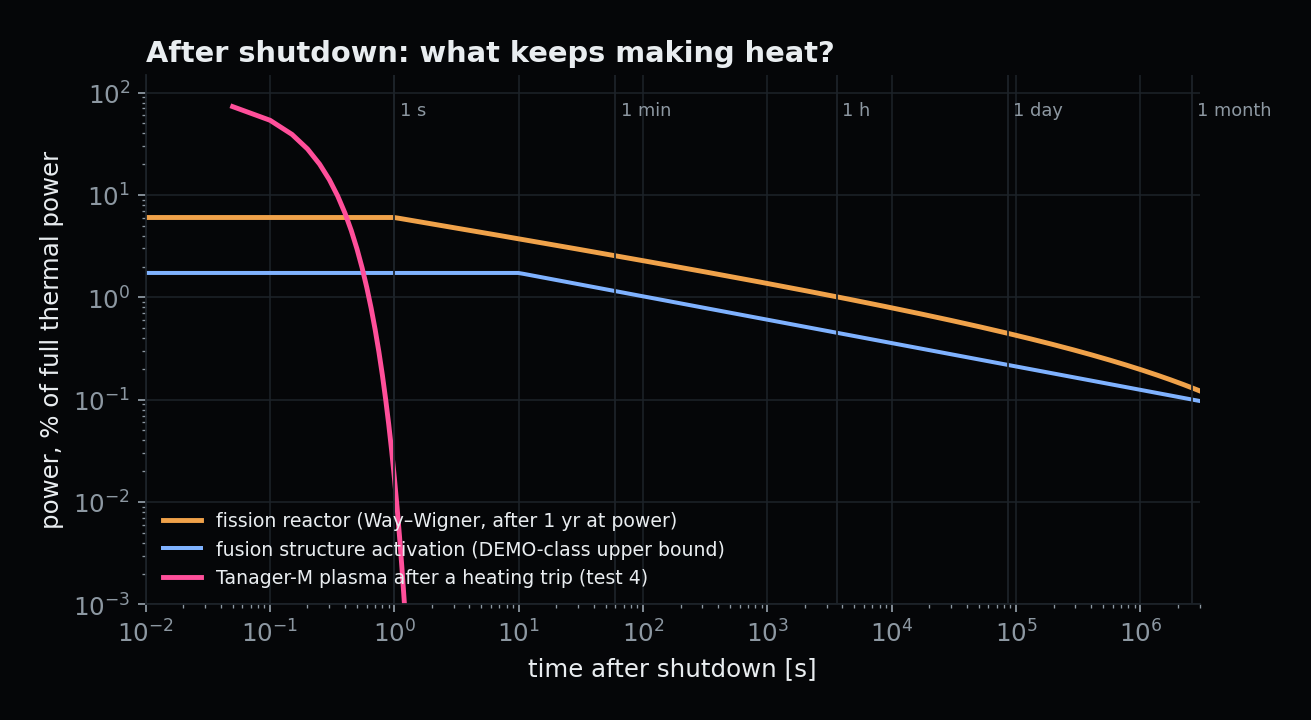
Log-log chart: fission decay heat stays above 1 percent for hours while Tanager-M's plasma power falls to zero within seconds
After shutdown. Fission keeps making heat for days; Tanager-M's plasma is out in 0.7 s.

Wins

  • No chain reaction to run away. Stop fuel or heating and the burn ends in about 0.7 seconds.
  • About 37 mg of fuel in the machine at any moment, against tonnes of uranium in a fission core.
  • No spent fuel and no plutonium. Waste is activated steel and tungsten.
  • Steady state with no plasma current to drive: no disruptions, unlike a tokamak.

Loses

  • It makes no net electricity. Its wall-plug gain would be about 0.23.
  • Tritium has to be bought in: 2.0 g per full-power day.
  • Breakeven needs better-than-average confinement: 5 % of simulated machines reach Q ≥ 1.
  • Twisted 20 T HTS coils have not been built yet.

Feasibility

Could it be built today?

Mostly. Every system below has been built somewhere at a scale close to what Tanager-M needs. The twisted high-field coils are the one real gap.

SystemTanager-M needsExists todayStatus
HTS magnetsPartly19.0 T peak, 20 twisted coils, ≈14,600 km of REBCO tape20 T large-bore REBCO coil (MIT/CFS, 2021); SPARC's 18 flat coils use ≈10,000 km of tape — Twisted stellarator HTS coils not yet built; Proxima's model coil targets 2027Partly
Plasma heatingExists39 MW ion-cyclotron heatingJET ran >30 MW ICRH; SPARC plans 25 MW at 12 TExists
FuellingExistsFrozen D-T pellets, steadyW7-X: about 90 pellets over a 43 s record plasma (2025)Exists
First wall and divertorPartly≈ 6 MW/m² with 70 % radiated in the divertorW7-X island divertor, tungsten components rated ≈10 MW/m² — Needs detached operation; attached it would be 20 MW/m²Partly
Neutron shieldExists60 cm tungsten carbide + waterWC shielding is industrial; studied for compact fusion — Magnets outlast the machine (≈800 full-power years)Exists
TritiumExists2.0 g per full-power day, bought inJET's D-T campaigns (1997, 2021, 2023); Canada's CANDU reactors supply tritium — No breeding blanket on this machineExists
Remote maintenancePartlyIn-vessel handling after D-TJET remote handling, ITER designs — Stellarator access through ports is harder than a tokamakPartly

A machine like this is a national-lab or well-funded-company project, in the same class as Wendelstein 7-X (about €1.1 billion). It is not a garage build.

Lineage

A step, not a leap.

Wendelstein 7-X proved optimised stellarators hold heat. SPARC shows what 20 T superconductors buy. Tanager-M is the stellarator version of that step, and the 12 m Tanager power plant is what it would lead to.

Swipe the table →

Wendelstein 7-XSPARCTanager-MTanager (plant)
TypeStellaratorTokamakStellaratorStellarator
StatusOperating since 2015First plasma 2027Simulated, 2026Concept
Major radius5.5 m1.85 m4.8 m12 m
Plasma volume30 m³20 m³61 m³433 m³
Field on axisup to 3 T12.2 T8.2 T10 T
FuelH, DD-T, 10 s pulsesD-T, steadyD-T, bred
Fusion gain—Q ≈ 11 predictedQ 0.34–0.97ignition in 0-D; blanket short of breeding

What I'm exploring next

A personal build, in the open.

No lab, no company, no deadlines. Just the next questions I want answered, in the order I'm taking them.

  1. Done

    The first concept

    A 12 m power-plant idea, checked against Proxima Fusion's published Stellaris numbers.

  2. Done

    Shrink it and test it

    DESC, SIMSOPT and OpenMC on a machine sized to today's materials. This page.

  3. Now

    Coils and plasma together

    Optimise both at once, with the plasma's own current included, to close the last 10 % of the edge.

  4. Next

    Point my AI at it

    Let my self-improving research system, the RSI Runtime Module, search for a smaller machine with the same tests.

  5. Always

    Share it and listen

    Publish every input and ask people who work in fusion what I'm getting wrong.

About

Why an AI researcher is designing a reactor.

I'm Junai P. Felix, an independent AI researcher. I'm not a nuclear engineer, and Tanager isn't a company. It's a personal exploration of new power sources and the efficiency gains that could make them practical.

My main work is self-improving AI systems. Tanager is where I point that work at a hard physical problem: start from the best published fusion research, test it with the tools the field uses, and report what comes out.

Every figure here is labelled for what it is. If you work in fusion and see a mistake, I want to hear it.

Focus
Self-improving AI systems
Exploring
New power sources, efficiency

Follow along

Watch it get built, one test at a time.